
Plaza San Martín is not only one of the most representative spaces in central Lima; it is also a key place for understanding how the city entered modernity during the 20th century. Inaugurated in 1921 as part of the celebrations for the centenary of Peru’s independence, the square was conceived as a grand urban setting dedicated to José de San Martín.
Surrounded by monumental buildings, historic hotels, and elegant European-inspired façades, the square quickly became one of the capital’s main social and cultural spaces. Iconic landmarks such as the Hotel Bolívar and the old cafés in the surrounding area reflect the importance this district held in Lima’s social life during the last century.
Beyond its architectural value, the square has also been the setting for demonstrations, celebrations, and political events that marked different moments in the country’s history. Today, it remains one of the most visited places in Lima’s Historic Centre and an essential stop for those wishing to discover the city’s monumental and republican side.
The origin of the first Great Republican Square
Plaza San Martín was born during the modernisation process that transformed Lima at the beginning of the 20th century. Its official inauguration took place on 27 July 1921, during the government of Augusto B. Leguía, as part of the celebrations for the centenary of Peru’s independence.
Before becoming a square, this space was occupied by the former San Juan de Dios Hospital and by areas linked to the railway that connected Lima with Callao. The redevelopment of the area aimed to create a monumental environment that would represent the urban growth and republican image of the capital.
The project incorporated European-inspired buildings, wide avenues, and a central monument dedicated to José de San Martín. Over time, the square became established as one of Lima’s main public spaces and as a meeting point for the city’s political, cultural, and social life.
The Monument to the Liberator of America

At the centre of the square stands the monument dedicated to José de San Martín, a leading figure in South American independence and a key figure in the proclamation of Peru’s independence in 1821. Since its inauguration in 1921, this sculpture has become the main symbol of Plaza San Martín and one of the most recognisable landmarks in Lima’s historic centre.
The work was created by the Spanish sculptor Mariano Benlliure and depicts the liberator on horseback in a composition designed to convey authority, leadership, and triumph. Its location was not accidental: the monument was conceived as the central axis of a square intended to represent the republican spirit of Peru during the centenary celebrations of independence.
One of the most talked-about details of the sculptural ensemble can be found in the allegorical figure located at the back of the monument. Above her head appears a llama, an element that gave rise to a popular Limeño anecdote. According to the story, the artist supposedly confused the Spanish word “llama”, meaning the Andean animal, with “llama” meaning flame or fire when interpreting the instructions sent from Peru. This detail eventually became one of the square’s most famous curiosities.
The structural and architectural beauty of the square

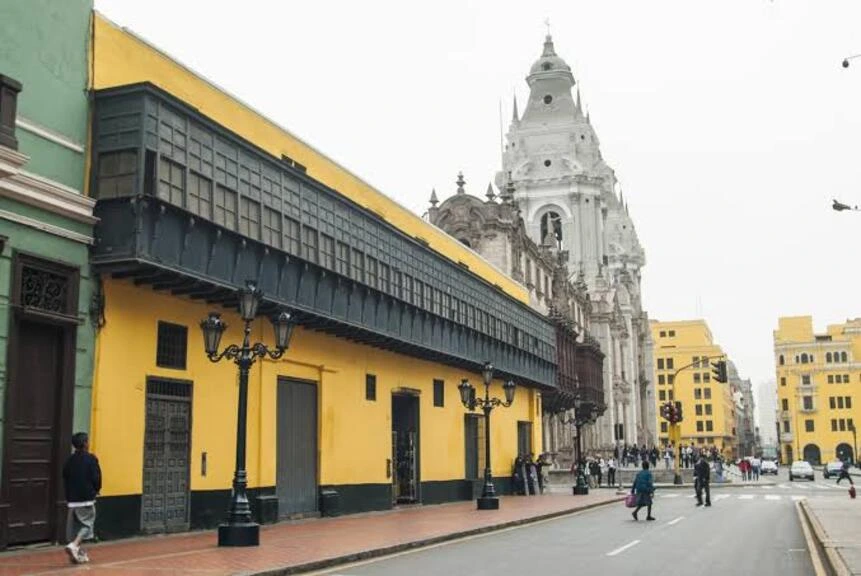
Plaza San Martín stands out for the harmony of its urban design and for the monumental style of the buildings surrounding it. From its inauguration in 1921, it was conceived as a modern and elegant space inspired by the grand European squares of the period. French influence can be seen in the symmetrical façades, ornate balconies, and architectural uniformity that give the square its distinctive identity.
Many of the buildings surrounding the square were constructed during the first decades of the 20th century. Among them are historic hotels, theatres, and commercial buildings that combined Neocolonial style with republican and academic influences. This architectural balance transformed the square into one of the main meeting points of Lima’s social and cultural life.
Because of its historical and urban value, Plaza San Martín forms part of Lima’s Historic Centre, recognised by UNESCO as a World Cultural Heritage Site in 1988. Today, it remains one of the most representative and photographed spaces in central Lima.
The historic Hotel Bolívar

One of the most representative buildings in the square is the Gran Hotel Bolívar, inaugurated in 1924 during the urban modernisation process promoted in central Lima. From its earliest years, the hotel became a symbol of elegance and one of the most prestigious accommodations in South America.
Thanks to its location facing Plaza San Martín, the hotel became the setting for political meetings, social events, and visits by artists, intellectuals, and international figures arriving in the Peruvian capital. Its republican architecture, inspired by European styles, reinforced the modern image that Lima sought to project throughout the 20th century.
Beyond its historical importance, the hotel still preserves part of the classic atmosphere of republican Lima. Its halls, corridors, and cafés maintain period details that continue to evoke the years of greatest splendour of the square. It is also famous for popularising the traditional Pisco Sour, one of Peru’s most iconic drinks.

Throughout the 20th century and up to the present day, Plaza San Martín has played a central role in Peru’s political and social life. Thanks to its strategic location in central Lima, this space became the setting for marches, demonstrations, national celebrations, and events that marked different moments in the country’s contemporary history.
Over the years, the square also became an important meeting point for citizens. Cultural activities, public events, and social gatherings regularly take place here, bringing together thousands of people in front of some of the capital’s most emblematic buildings.
This combination of historical value and everyday urban life has kept Plaza San Martín as one of the most representative spaces in central Lima and one of the city’s most visited locations.
Tourist attractions near Plaza San Martín
Jirón de la Unión

Jirón de la Unión is one of the most traditional and busiest streets in Lima’s historic centre. From the late 19th century and throughout much of the 20th century, it was one of the main meeting points of Lima’s social life, frequented by merchants, intellectuals, and families from the capital.
This pedestrian street connects Plaza San Martín with Lima’s Plaza Mayor, crossing an area filled with history and republican architecture. Along the route, it is possible to find old mansions, galleries, traditional cafés, and commercial buildings that showcase Lima’s urban evolution over the years.
Walking along Jirón de la Unión also allows visitors to discover some of the most representative corners of central Lima, following a route where historical heritage and the city’s everyday movement coexist side by side.
Plaza Mayor of Lima

The Plaza Mayor of Lima, also known as Plaza de Armas, is the place where Francisco Pizarro founded the city of Lima on 18 January 1535. Since the viceregal era, this space became the political, religious, and administrative centre of the Peruvian capital.
Around the square, some of the city’s most important buildings were constructed, including Lima Cathedral, the Government Palace of Peru, and the Municipal Palace. These buildings reflect the importance Lima held as the capital of the Viceroyalty of Peru and as one of the main centres of power in South America.
Thanks to its proximity to Plaza San Martín, both spaces can be explored within the same route through the historic centre, following some of Lima’s most traditional and monumental streets.
Church of La Merced

The Basilica and Convent of Nuestra Señora de la Merced is one of the oldest and most representative churches in Lima’s historic centre. Its origins date back to the 16th century, only a few years after the foundation of the city, when the Mercedarian order established itself in the then “City of Kings”.
Throughout the viceregal period, the church gained great religious and social importance. Its current Baroque façade, considered one of the finest in Lima, reflects both the artistic influence of the colonial era and the power held by religious orders within the city.
Located along the traditional Jirón de la Unión, the church forms part of the historic route connecting Plaza San Martín with Plaza Mayor, right in the heart of the former viceregal centre.
Tips before visiting Plaza San Martín
The best time to visit

Plaza San Martín can be visited at any time of the day, although many travellers prefer to explore it during the afternoon and the early evening hours. At that time, the lighting highlights the republican façades and the monument to José de San Martín, creating one of the most representative scenes in Lima’s historic centre.
In addition, the atmosphere is usually calmer for walking, appreciating the architecture, and exploring the cafés, hotels, and historic buildings surrounding the square.
How to get there from other parts of Lima


Plaza San Martín is easily accessible from different parts of Lima and forms part of one of the best-connected areas in the historic centre.
If you are staying in Miraflores or Barranco, one of the most practical ways to get there is by using the Metropolitano bus system. From either district, you can head to the stations located along the Vía Expresa Paseo de la República and take a bus towards central Lima. The most recommended stations to get off at are Colmena or Jirón de la Unión. From there, you only need to walk a few minutes along Nicolás de Piérola Avenue or the traditional Jirón de la Unión until you reach the square.
You can also choose to travel by taxi or ride-hailing apps. In that case, the most common routes usually follow the Vía Expresa before connecting with important avenues such as Grau, Abancay, or Nicolás de Piérola, one of the most representative historic arteries of central Lima.
If you are already in Cercado de Lima or near Plaza Mayor, you can easily reach the square on foot via Jirón de la Unión. This route connects two of the city’s most emblematic spaces and allows visitors to admire old mansions, churches, and republican buildings throughout the historic centre.
What to see and do in Plaza San Martín?

Exploring Plaza San Martín is one of the best ways to discover the historical and republican character of central Lima. Its surroundings preserve buildings constructed during the first decades of the 20th century, featuring monumental façades, ornate balconies, and a strong European architectural influence that reflected the capital’s modernisation process.
In addition to admiring the square and taking photographs, you can visit iconic places such as the Gran Hotel Bolívar, inaugurated in 1924 and considered for many years one of the most important hotels in South America. Its halls, cafés, and traditional spaces form part of Lima’s urban memory.
The square has also become one of the main starting points for walking tours through the historic centre. These tours allow visitors to discover old passageways, republican buildings, and stories connected to Lima’s transformation from the viceregal era to the 20th century.
From here, you can also easily walk to other historic landmarks such as Jirón de la Unión, Plaza Mayor, and the Basilica of La Merced, following one of the most traditional urban routes in central Lima.
The current importance of Plaza San Martín

Today, Plaza San Martín continues to be one of the most representative spaces in Lima’s historic centre. Its importance lies not only in its republican architecture or in the events that shaped its history, but also in the role it continues to play in the social and cultural life of the capital.
Since its inauguration in 1921, the square has been the setting for patriotic celebrations, official ceremonies, public demonstrations, and civic gatherings that reflect different moments in Peru’s contemporary history. Thanks to its strategic location, it became firmly established as one of the main meeting points in central Lima.
Today, surrounded by monumental buildings, historic hotels, and traditional cafés, Plaza San Martín still preserves much of the atmosphere of republican Lima from the early 20th century. In addition, its connection with Jirón de la Unión and Plaza Mayor makes it an essential stop on any tour of Lima’s Historic Centre.