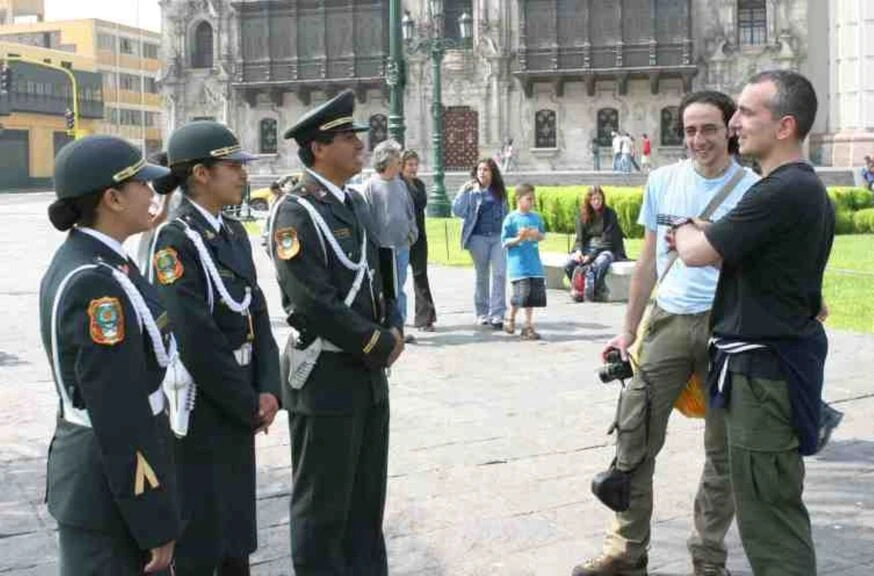

In Cusco’s Historic Centre, you won’t need a drone to capture panoramic views of the city founded by Manco Capac and Mama Ocllo. From the Plaza de Armas, all you need to do is walk for about 15 to 20 minutes to reach the viewpoint in the San Cristóbal neighbourhood, where your eyes will take in the urban and natural grandeur of the place known as the “navel of the world”.
San Cristóbal is one of the historic neighbourhoods of the “Imperial City”. Its origins date back to the early days of the Inca State, when this area served as a storage zone for agricultural products. According to information gathered by colonial chroniclers, it was known as Qolqampata — a name which, when translated into English, means an elevated area (pata) with storehouses or granaries (qolqa).
And this elevated area, sitting at more than 3,500 metres above sea level, is perfect for admiring Cusco at sunrise or as the sun sets at dusk. The views are equally striking beneath the dark mantle of night. You simply can’t go wrong. Visit once — or more — and let your eyes become the cameras of a drone that doesn’t need to fly to reveal the urban geography of the “Historic Capital of Peru”.
A neighborhood with history
It was the Spanish magistrate, encomendero and chronicler Juan Polo de Ondegardo y Zárate (Valladolid, 1500 – La Plata, 1575) who founded the parish of San Cristóbal in 1559, to the north-east of Cusco’s Plaza de Armas and south of the archaeological park of Saqsaywaman. Yet the story of this picturesque and traditional urban area dates back much further — to the very origins of Inca civilisation.
The “Children of the Sun” called this area Qolqampata or Qolcampata, a zone of andenes (agricultural terraces) and qolqas (storehouses or granaries) where the palace of Manco Capac — the founder of the city and the first Inca — is believed to have stood. Legend tells that, together with his wife Mama Ocllo, he emerged from the waters of Lake Titicaca (Puno) to create a civilisation by command of his father, the Sun.
As Cusco’s power grew stronger across the Andes under the rule of Pachacutec — the “Transformer of the World” — Qolqampata became the first neighbourhood established beyond the city’s original founding core. Later, during the colonial period, the Spanish divided the lands of Cusco, granting this area between the Tullumayo and Saphi rivers to one of the descendants of the Inca nobility.
The Church of Saint Christopher
Paullu Inca, son of Huayna Capac and brother of Huascar and Atahualpa — who fought one another in a civil war for control of the empire — maintained friendly relations with the Western conquerors. In recognition of his support and collaboration, the Iberians granted him lands in Qolqampata. In 1543, this “Son of the Sun” chose to be baptised, taking the name Cristóbal Paullu Tupac Inca.
After converting to Christianity, he promoted the construction of a chapel, which would later receive the name San Cristóbal, in honour of the close friendship between the Cusco nobleman — who was eventually buried in the temple — and Cristóbal Vaca de Castro. Vaca de Castro had been sent to the New World by Emperor Charles V with the mission of mediating in the conflict between the forces of the conquistadors Francisco Pizarro and Diego de Almagro.
San Cristóbal was built upon the foundations of a pre-Hispanic huaca (sacred temple). Designed in the shape of a Latin cross and featuring a bell tower with eight windows, it is the highest church in the city. For this reason, its square — or atrium — has become one of the most visited viewpoints in Cusco, both for its easy access and for its beautiful views over the Historic Centre, declared a UNESCO World Heritage Site.
The routes to the viewpoint

From the Plaza de Armas (3,400 m above sea level), there are several routes leading to San Cristóbal Church and its viewpoint, two attractions that share the same urban space (3,500 m above sea level). Before setting off, keep in mind that you don’t need to be an athlete to reach your destination. The distance is relatively short (between 500 and 800 metres, depending on the route you choose), and the ascent is only about 100 metres.
You can decide which path to take as you make your way towards the cobbled streets of San Cristóbal and the panoramic views over Cusco. A recommended route is to take Cuesta del Almirante (using the Cathedral as your reference point) and continue along Ataúd and Arco Iris streets until you reach Don Bosco Street. At this point, turn left to arrive at the parish church and viewpoint. Distance: 550 m. Time: 15 to 20 minutes.
There are also alternative access routes via Resbalosa and Ccoricalle streets. In every case, you will eventually reach Don Bosco — that’s the key point to remember. Always keep in mind that your destination lies to the north-east of the Plaza de Armas. If you enjoy walking in a group, join one of our free walking tours, which will allow you to explore the artisan neighbourhood of San Blas and the San Cristóbal viewpoint — the most impressive in Peru’s leading destination.
What will you see from San Cristóbal

Watching Cusco from the San Cristóbal viewpoint is truly priceless. Entry is free throughout the day, so slip away whenever you can and witness how the former capital of the Inca Empire transforms as the sun shines brightly or as misty clouds announcing rain appear on the horizon. It is equally magical when the city lights switch on, cutting through the darkness of the night.
It is a genuine spectacle in which you will enjoy bird’s-eye — or drone-like — views of the Plaza de Armas, known as Huacaypata (“Place of Weeping”) in pre-Hispanic times; colonial churches built upon the stone foundations of Inca temples; grand mansions raised over the palaces of Cusco’s rulers; and the traditional districts of San Sebastián and San Jerónimo, among many other urban details.
These sweeping panoramic views are framed by the Andean peaks. From San Cristóbal, it is even possible to glimpse Ausangate, the snow-capped mountain rising to 6,384 metres, which is revered as an Apu. In the worldview of the ancient people of Cusco, the Apus are sacred and protective mountains. Ceremonies and rituals are performed in their honour using coca leaves, chicha and other offerings.
The attractions of the neighborhood
Make the most of your visit to the San Cristóbal neighbourhood and viewpoint by stopping at the Sapantiana colonial aqueduct, a place that, long before the arrival of the Spanish, served as a spiritual and ceremonial site of reverence. Another picturesque and highly Instagrammable spot is 7 Borreguitos Street, a small yet charming cobbled lane that was traditionally used by shepherds as they guided small flocks of sheep.
Within the neighbourhood, you will also find the palace of Qolqampata or Qolcampata, built by order of Manco Capac, the founder of Inca civilisation. Today, it forms part of the infrastructure of a hotel, whose owners have carefully restored its stone walls. Be sure to take a moment to admire this historic site, located just opposite the colonial church of San Cristóbal.
Who was Saint Christopher
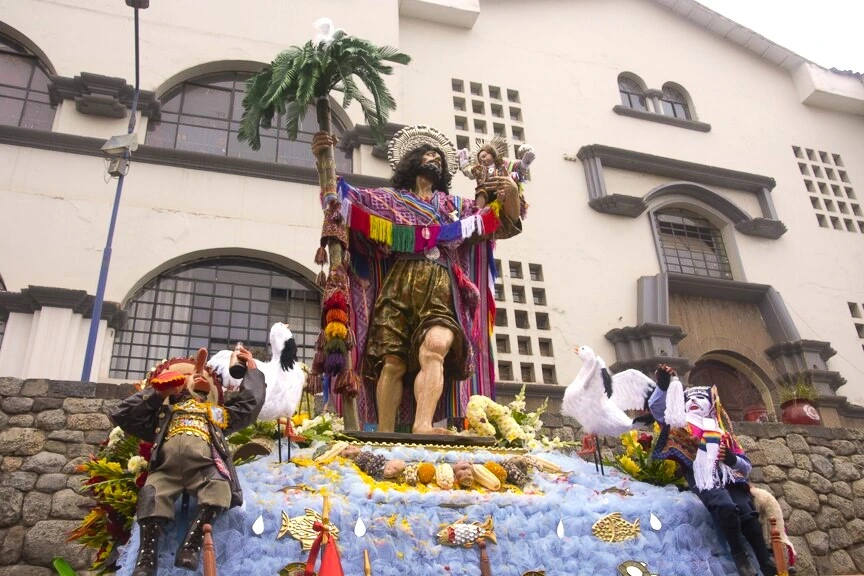
In the 3rd century AD, a strong man named Reprobus was determined to serve the most powerful king. During his search, he came to believe that the Devil held that power, so he decided to follow and serve him. One day, while travelling along a road where a cross stood, Satan suddenly stopped and chose a different route. Surprised by this reaction, Reprobus realised that there must be someone even more powerful.
“Who could that be?” he wondered, until an old hermit spoke to him about Christ and offered him some advice: move to the banks of a river where many travellers lost their lives while trying to cross. Your mission, he said, would be to help them reach the other side. On one occasion, a child asked for his help. Reprobus agreed and carried the child on his shoulders. When they reached the opposite bank, the child revealed himself as Jesus, the Son of God.
The story of Reprobus is the story of Saint Christopher of Lycia, the protector of travellers. So, feel safe as you explore his viewpoint and neighbourhood. Keep in mind that on 2 August, the patron saint is honoured with such devotion that the celebration was declared National Cultural Heritage in 2018. Not only that — his image is also one of those that takes part in Cusco’s magnificent Corpus Christi festival.
Travel tips
*Protect yourself: If you visit the San Cristóbal viewpoint during the day, wear a hat or cap. Don’t forget to apply sunscreen as well.
*Take it steady: Rushing is not your best companion here. Walk at a relaxed pace towards the viewpoint so you can fully appreciate Cusco’s impressive urban landscape.
*Don’t forget: Always carry your ID card or passport in case you need to identify yourself.
*Money: Although entry is free, it’s a good idea to carry coins and small banknotes for minor expenses.
*Enhance your view: If you have binoculars, bring them along to use at the viewpoint — you may be pleasantly surprised by what you can spot.
*Be prepared: Carry some water and a few snacks in case your visit lasts longer than expected.